First drive in Mission Valley Keep right · 25 mph · signal 100 feet
Keep to the right half of the road, drive no faster than 25 mph on a residential street unless a sign says otherwise, and signal during the last 100 feet before every turn.
CVC 21650 (right half of the road) · CVC 22352(b)(1) (25 mph in a residence district) · Handbook, "Blind Intersections"; CVC 22352(a)(2) (15 mph at a blind intersection) · CVC 22108 (signal for the last 100 feet)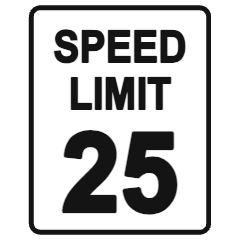
What is the speed limit on a residential street in California?
Unless a sign says otherwise, 25 mph in a residence or business district (CVC 22352(b)(1)). At a blind intersection it is 15 mph.
Why this rule exists
Keeping right leaves room for oncoming traffic. At 25 mph you can still stop for a child stepping out between parked cars. An early signal tells everyone what you are about to do.
Step by step on the road
- Keep to the right half of the road (CVC 21650), in the middle of your lane.
- On a residential street with no speed sign, drive no faster than 25 mph.
- Know where you will turn, and signal during the last 100 feet before it, about six car lengths. Keep the signal on until you turn (CVC 22108).
- Ease off the gas early, so you brake before the corner, not in it.
- At a corner with no STOP signs, slow to 15 mph: the Handbook counts it as a blind intersection.
- After the turn, make sure your signal is off.
Common mistakes
- Signaling only as you start to turn, instead of during the last 100 feet.
- Signaling so early, before an earlier side street, that other drivers think you turn there.
- Taking a corner without STOP signs at 25 mph, where the limit is 15.
- Drifting toward the middle of a street without lane lines.
On the DMV drive test
On residential and business streets the DL 32 score sheet marks your speed, your spacing and your lane position, and DL 955 wants the car kept in the center of the lane. Signal at least 100 feet before each turn, but not so early that other drivers will not understand what you plan to do. Keep to the speed limit and slow down for hazards. Driving 10 mph over the limit, or 10 mph under it when nothing calls for a lower speed, is a critical driving error: the test is failed.
Based on the DMV’s Driving Test Criteria (DL 955) and its score sheet (DL 32). How the drive test works ›Questions people ask
How far before a turn do you have to signal in California?
Continuously during the last 100 feet before the turn (CVC 22108). That is about six car lengths, so switch it on before you start to brake for the corner.
What is a blind intersection in California?
The Handbook calls an intersection blind if it has no STOP signs at any corner, and gives it a 15 mph limit. The law (CVC 22352(a)(2)) sets 15 mph where, in the last 100 feet, you cannot see 100 feet along the cross roads.
Do you have to drive on the right half of the road in California?
Yes. CVC 21650 says to drive on the right half of the roadway, except to pass, to turn left, or when the road is blocked.
Did you know?
- On the DMV drive test, driving 10 mph or more over the speed limit is a critical error: the test is failed.
- 100 feet is about six car lengths: signal before you start to brake for the corner.
- An intersection with no STOP signs at any corner counts as blind: the Handbook gives it a 15 mph limit.
Test yourself
1A residential street with no speed limit sign. The limit is…
- 15 mph
- 25 mph
- 30 mph
- 35 mph
Show the answer
B: 25 mph. CVC 22352(b)(1): 25 mph in a business or residence district unless a different limit is posted. The Handbook: "25 mph, unless otherwise posted."
2How far before a turn must your signal be on?
- Only once you start to turn
- At least 50 feet
- At least 100 feet
- At least 500 feet
Show the answer
C: At least 100 feet. CVC 22108: the signal is given continuously during the last 100 feet traveled before turning.
3On a two-way street without lane lines, you drive…
- in the middle
- on the right half of the road
- wherever there is most room
- on the left, to see better
Show the answer
B: on the right half of the road. CVC 21650: drive on the right half of the roadway, except to pass, to turn left, or when the road is blocked.
Kees' tip
Signal as soon as you know where you will turn, then ease off the gas early: take the corner slowly and stay close to the right.