Sharp bends Bochten: op tijd remmen
Brake before a sharp bend, on the straight, to the advice speed on the blue sign (A4); in the bend keep a steady speed and stay in your lane.
RVV 1990 art. 19 · signs J2, J3, A4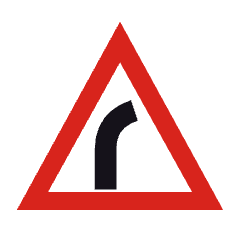
Hoe hard mag je door een scherpe bocht?
Rem vóór de bocht, op het rechte stuk, tot de adviessnelheid op het blauwe bord (A4) onder het waarschuwingsbord. In de bocht houd je een gelijke snelheid en blijf je in je eigen rijstrook.
In English: How fast can you take a sharp bend? Brake before the bend, on the straight, to the advice speed on the blue sign (A4) under the bend warning. In the bend keep a steady speed and stay in your own lane.
Why this rule exists
In a bend the car is pushed to the outside, more the faster you go (twice the speed is four times the push). Braking hard in the bend itself can make the car slide; cutting the bend puts you in front of oncoming traffic you cannot see yet.
The Dutch words you need
- bocht
- bend, curve
- scherpe bocht
- sharp bend
- adviessnelheid
- advisory speedthe blue square sign A4 under a bend warning
- bord J2 / bord J3
- sign J2: bend to the right / sign J3: bend to the left
- bochtschild
- chevron boardthe board with arrows on the outside of a bend
- afsnijden
- to cut (a bend)
Step by step on the road
- A bend warning (J2 or J3) with a blue sign (A4) under it: the bend is sharp, and the blue sign gives the speed to take it at.
- Brake on the straight, before the bend, to that speed or lower.
- Keep your eyes far ahead through the bend, where you are heading.
- In the bend keep a steady speed and stay in your own lane; in a left-hand bend keep a little to the right.
- Where you cannot see the end of the bend, keep your speed constant and only speed up once you can see all of it.
- Accelerate gently as the bend opens up.
Common mistakes
- Braking in the middle of the bend, where the car slides more easily.
- Going much faster than the blue advice speed because it is "only advice".
- Cutting a left-hand bend over the centre line, towards oncoming traffic you cannot see yet.
- Overtaking just before or in a bend you cannot see through.
In the driving exam
The CBR wants you to judge a bend early, from its shape, the width and surface of the road and the "language of the road", such as chevron boards and verge posts. You set your speed before you steer in, so you hardly need to brake in the bend, and you drive the bend at an even speed in the right place on the road. In a bend you cannot see through, you speed up only once you can see the whole of it. The CBR also warns of a bend that gets sharper halfway (a "nabocht"): there your speed matters even more.
Based on the CBR's driving procedure for category B (Rijprocedure B).Questions people ask
Is the blue advisory speed sign a legal limit in the Netherlands?
No. The blue square sign A4 is advice, not a legal limit. But going much faster means driving too fast for the road, and that is against the law (RVV 1990 art. 19).
Should you brake in a bend?
Try not to. Brake before the bend, while the wheels are straight; in the bend keep a steady speed and accelerate gently as it opens. Braking hard in a bend can make the car slide.
What does sign J2 mean?
Sign J2 warns of a dangerous bend to the right ahead; J3 is the same for a bend to the left. Sometimes a blue sign under it gives the advice speed for the bend.
Test yourself
Kees' three questions on this rule, the “Wist je dat?” facts and his tip come with the drive, in Voorrah! Pro.
Get Voorrah! Pro ▸